

Indianapolis Motor Speedway | May 24, 2026 | NTT IndyCar Series
INDIANAPOLIS — Felix Rosenqvist had been here before. Well, almost.
Seven times the 34-year-old Swede had strapped himself into an IndyCar and pointed it toward Turn 1 on Race Morning at Indianapolis Motor Speedway. Seven times the Month of May had ended without a trip to Victory Lane, without a drink of milk, without a place in the history books.
Sunday was going to be different. It had to be.
It was — in ways that no one, not even Rosenqvist himself, could have scripted.
In a finish that left 350,000 spectators — every one of them holding a ticket that had sold out for the second consecutive year — clutching their neighbors and gasping for air, Rosenqvist drove his No. 60 SiriusXM Honda for Meyer Shank Racing past David Malukas in the final yards of the final lap of the 110th Indianapolis 500 to win by .0233 of a second — the closest margin of victory in the century-plus history of “The Greatest Spectacle in Racing.”
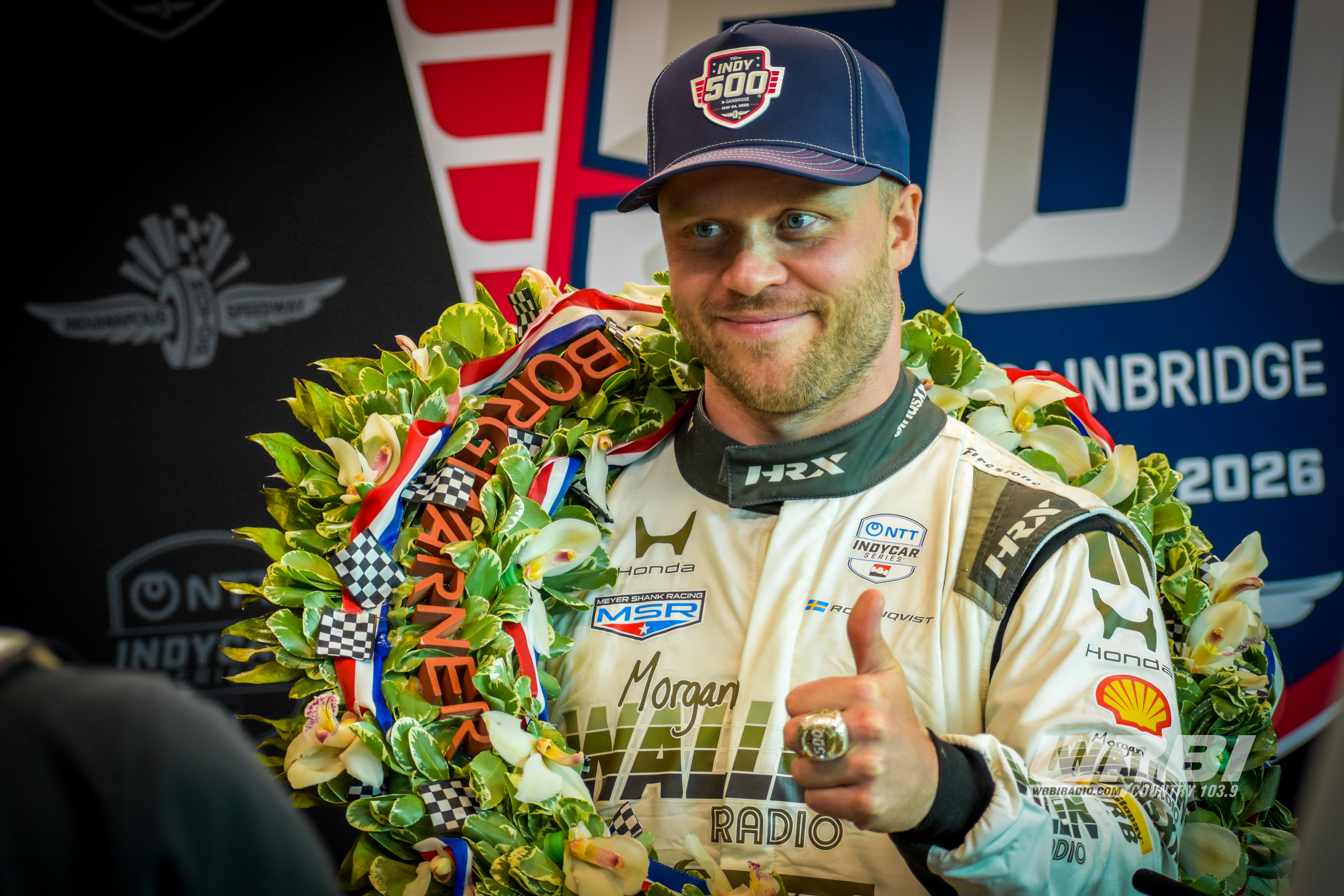
Felix Rosenqvist gives a thumbs-up in Victory Lane after winning the 110th Indianapolis 500 presented by Gainbridge on Sunday at Indianapolis Motor Speedway. Photo: Annie Nunley / WRBI Radio
“Unreal. I still don’t believe it. It was just the coolest way you can finish and win an Indy 500.”
— Felix Rosenqvist, 2026 Indianapolis 500 winner
History by the hundredths
The number .0233 is now forever etched into the granite walls of Indianapolis Motor Speedway lore. It is smaller than the blink of a human eye. It is the difference between immortality and heartbreak.
The previous record for closest finish had stood for 34 years — Al Unser Jr. beating Scott Goodyear by .043 of a second in 1992, a finish that had long been considered untouchable, a unicorn of motorsports drama. Rosenqvist and Malukas cut it nearly in half.
Malukas, driving the No. 12 Verizon Team Penske Chevrolet, powered his way to the lead entering Turn 1 on that final, electric lap and began to pull away on the backstretch. He had the momentum. He had what appeared to be a commanding advantage. He had everything — except, as it turned out, the win.
Rosenqvist, running the high line against the concrete wall through Turn 4, found a sliver of clean air and an extra gear that neither he nor anyone else may have known existed. He surged. Malukas, sensing the charging Honda in his mirrors, slid toward the pit wall to try to break Rosenqvist’s aerodynamic tow, then moved back toward the center of the track. Rosenqvist swung back to the outside, narrowly avoiding contact, and with the checkered flag in the air and the crowd on its feet, nosed ahead.
By inches, it seemed. Rosenqvist nosed ahead and crossed the Yard of Bricks first, and 0.0233 seconds changed everything.
“I don’t know what else we could have done,” Malukas said, choking back tears in his pit box. “We were the fastest car that whole race. I gave it 150 percent. I mean, I almost crashed this damn car every lap, and we still ended up with a P2. I just can’t believe it.”
A race worthy of the history books long before the finish
The closing drama would have been sensational enough on its own. But the 110th Indianapolis 500 had been building toward something extraordinary for all 200 laps.
The race set an event record with 70 lead changes — breaking the previous mark of 68 set back in 2013 — and featured 14 different lap leaders, the kind of number that keeps race historians busy for weeks. There were seven caution periods, a red flag, a fuel strategy chess match that stretched over dozens of laps, and a cast of characters that ranged from wily veterans to wide-eyed rookies.
Pole sitter Alex Palou, driving the No. 10 DHL Chip Ganassi Racing Honda, led a race-high 59 laps and looked for much of the afternoon like the class of the field. Scott Dixon, Palou’s Ganassi teammate in the No. 9, traded the lead with Palou a staggering 26 times — a new Indianapolis 500 record, shattering the previous mark of 18, set between James Hinchcliffe and Ryan Hunter-Reay in 2016. Dixon’s 32 laps led on Sunday extended his all-time career laps-led record at Indianapolis to 709, a number that seems destined to stand forever.
But neither Palou nor Dixon would kiss the bricks. Palou, who had earned the NTT P1 Award for the pole and added 12 bonus points, finished seventh after the late-race shuffling reshuffled the deck entirely. He still leads the series standings — by 42 points over Malukas — heading into next weekend’s Chevrolet Detroit Grand Prix. His afternoon was further complicated when post-race technical inspection revealed the front wing on his No. 10 car failed the minimum height measurement. INDYCAR Officiating determined the violation was the result of an assembly error rather than intentional cheating, and penalized Palou and Chip Ganassi Racing five championship points and $10,000.
Scott McLaughlin finished third in the No. 3 Pennzoil Team Penske Chevrolet, and Pato O’Ward fourth in the No. 5 Arrow McLaren Chevrolet — O’Ward’s fifth top-four result in seven career “500” starts, still without a victory. Marcus Armstrong, Rosenqvist’s Meyer Shank teammate in the No. 66 Acura Honda, was fifth.
Remarkably, the top five finishers were separated by only .4360 of a second. In a race that ran for three hours, five minutes and nine seconds, the difference between first and fifth was less than half a tick of the clock.
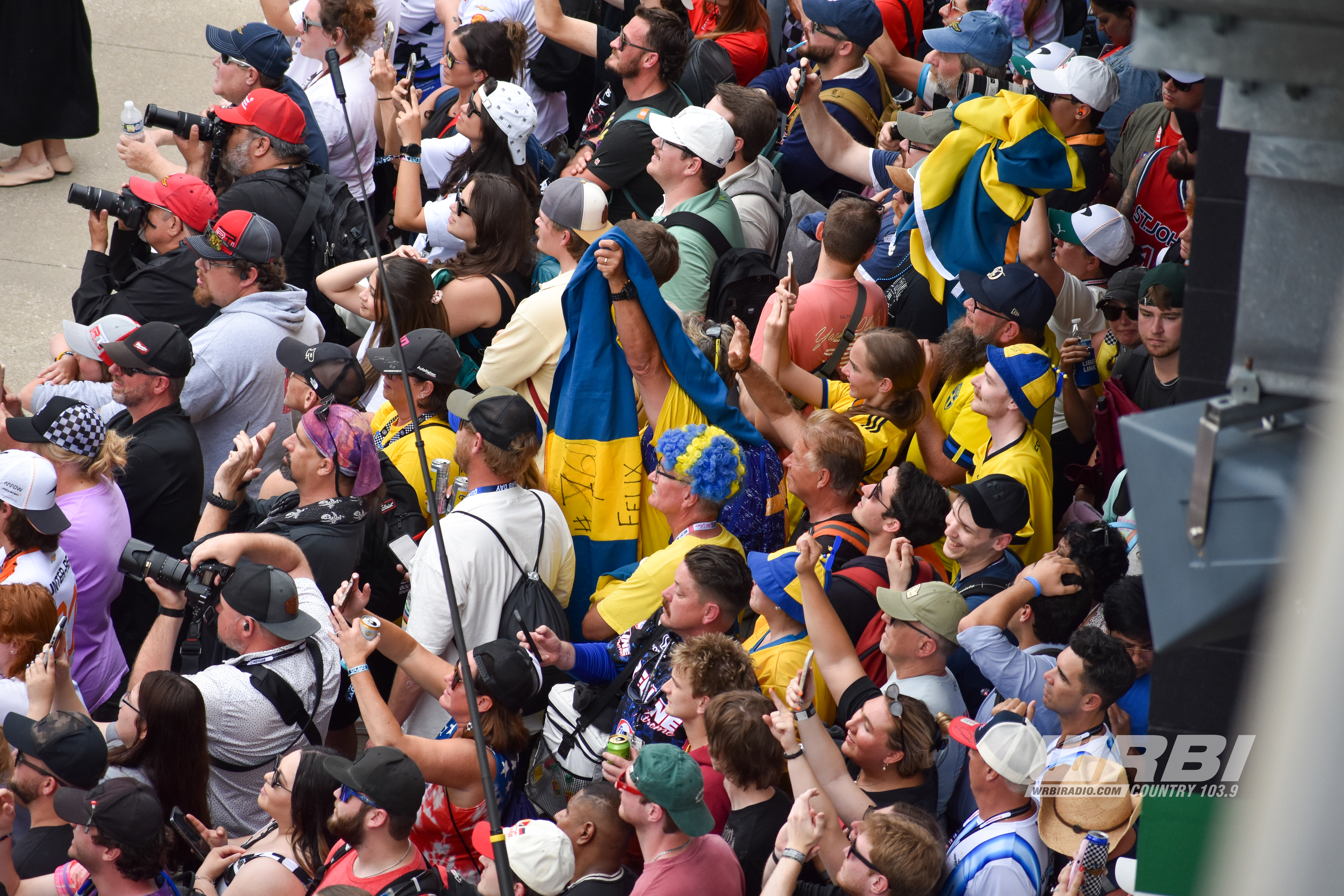
Swedish fans — many in yellow and blue national colors, waving their country’s flag — erupt in the grandstands as Rosenqvist takes the checkered flag. Photo: Annie Nunley / WRBI Radio
The strategy game that set up the drama
The seeds of Sunday’s breathtaking finish were planted 35 laps from the end, in the quiet calculus of fuel strategy that defines so much of what happens at Indianapolis.
O’Ward, Armstrong and Rosenqvist made their final green-flag pit stops on Laps 164, 165 and 166 respectively, gambling that they could stretch their fuel to the finish without stopping again. Meanwhile, Malukas, McLaughlin and Palou pitted later — Malukas on Lap 175, with Palou and McLaughlin on Lap 176 — giving that group fresher tires but leaving them more than 20 seconds behind the leading trio with fewer than 25 laps to go.
What looked like a comfortable advantage for Rosenqvist and company evaporated on Lap 192 when rookie Caio Collet — running the No. 4 Combitrans Amazonia Chevrolet for A.J. Foyt Enterprises — slammed the SAFER Barrier hard in Turn 2. Race officials immediately threw the red flag, pulling all cars into the pits and wiping out the gap that had taken dozens of laps to build.
The field was reset. The chess match was over. What remained was pure, uncut racing.
“It actually was good when I got back to third because it felt like I was hunting instead of being hunted.”
— Felix Rosenqvist
When racing resumed for the Lap 196 restart, Armstrong made a bold outside move in Turn 1 to grab the lead in the four-wide scramble, with Malukas riding his aerodynamic coattails to second. The fight for the win was on.
Then, on Lap 197, rookie Mick Schumacher — running a quietly impressive race in the No. 47 Rahal Letterman Lanigan Honda — brushed the SAFER Barrier in Turn 2, bringing out one final caution. One lap to decide everything.
Armstrong had the lead at the white flag. Malukas was second. Rosenqvist was third.
The rest is history.
A Swede, a team, and a month to remember
Felix Rosenqvist becomes only the third Swedish driver to win the Indianapolis 500, joining Kenny Brack (1999) and Marcus Ericsson (2022). He is 34 years old — the same age Helio Castroneves was when he won in 2009.
For Meyer Shank Racing — the Ohio-based team founded by businessman Mike Shank — Sunday’s victory is its second Indianapolis 500 win and, remarkably, its second NTT INDYCAR SERIES victory overall. Both wins have come in the biggest race in the world. Helio Castroneves captured his record-tying fourth “500” for MSR in 2021.
But for Rosenqvist, the victory carries a weight of emotion that goes far beyond motorsport. On May 4 — just three weeks before the race — he and his wife, Emille, welcomed their first child, a daughter named Stella.
“This whole month, becoming a dad and winning the ‘500’… We joked about it in the beginning: ‘Maybe you’ll win the ‘500’ and have a baby.’ It’s just unreal.”
— Felix Rosenqvist
It is also worth noting what Sunday’s finish means in the broader tapestry of Indianapolis lore. It marks the fifth time in “500” history that the leader lost the race on the final lap — Malukas joining Pato O’Ward (2024), Marcus Ericsson (2023), J.R. Hildebrand (2011) and Marco Andretti (2006) as drivers who led into the last lap and left without the win. In each case, the margin was cruelty itself.
The rest of the story
Romain Grosjean advanced from 24th on the starting grid all the way to ninth — more positions gained than any other driver. Mick Schumacher, despite his Lap 197 brush with the wall, was the top-finishing rookie in 18th. Conor Daly turned the fastest single lap of the race at 225.126 mph on Lap 182.
Veteran Helio Castroneves, making his 26th career “500” start, was running competitively before mechanical trouble ended his day on Lap 194. He did reach one milestone: on Lap 112, Castroneves surpassed A.J. Foyt as the Indianapolis 500’s all-time mileage leader, now having completed 12,480 miles in the event.
Ed Carpenter completed his 23rd career start without a victory — the most winless starts of any driver in Indianapolis 500 history, surpassing George Snider’s 22 — before contact ended his day on Lap 26. Josef Newgarden, the two-time defending “500” champion, was collected in an incident on Lap 124. Will Power’s day ended mechanically on Lap 91.
Rosenqvist’s words for Malukas said everything
In the chaos of Victory Lane, with milk dripping from his chin and the wreath of white flowers draped around his neck, Felix Rosenqvist found a moment of grace.
“Good job to Marcus and David at the end,” he said of Armstrong and Malukas. “They raced really cleanly. It’s because of drivers like that you get really good racing. Unbelievable.”
It was unbelievable. All of it — the finish, the records, the drama, the heartbreak and the joy. The 110th Indianapolis 500 was the kind of race that reminds you why this place, this event, this impossible, improbable, irreplaceable spectacle has been drawing people to the corner of Georgetown Road and 16th Street for more than a century.
For 350,000 people lucky enough to hold a ticket on Sunday afternoon in Indianapolis, it will never get old.
And .0233 of a second will live forever.
The NTT INDYCAR SERIES continues next Sunday, May 31, with the Chevrolet Detroit Grand Prix presented by Lear on the streets of Detroit.