
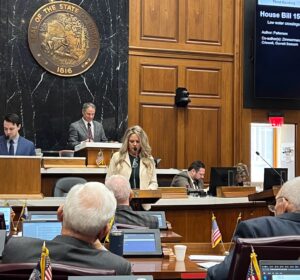
(Indianapolis) – Indiana lawmakers are preparing for a fast-moving 2026 legislative session with an ambitious education agenda that includes stricter cellphone restrictions in schools, renewed investment in STEM education and continued scrutiny of how schools are funded and operated.
The session resumes next week and will run only through late February, shortened after legislators already met for two weeks in December to handle redistricting. Senate bills must be filed by Jan. 9, with House bills due Jan. 14.
Education leaders previewed many of the coming debates at a legislative conference last month in Indianapolis, citing ongoing concerns about academic recovery, declining enrollment, student disengagement and the growing role of technology in children’s lives.
Push for broader cellphone bans
One of the most visible proposals would significantly expand restrictions on student cellphone use.
Current Indiana law, passed in 2024, requires schools to ban cellphone use during instructional time unless a teacher allows it for academic purposes. Senate Bill 78 would go further, prohibiting cellphone use throughout the entire school day — “from bell to bell” — including lunch and passing periods, with limited exceptions.
The bill, authored by Sen. Jeff Raatz, R-Richmond, was heard in the Senate Education Committee in December. Raatz said a committee vote is expected early this month.
Supporters argue broader bans would reduce distractions and improve student focus and mental health. Some parents and students, however, have raised concerns about emergency access and local decision-making.
Indiana Secretary of Education Katie Jenner said the issue extends beyond classrooms and reflects broader concerns about children’s relationship with technology.
“I cannot tell you how much it is impacting our children,” Jenner said. “We are seeing seven- and eight-year-old[s] with social media accounts. We are seeing nine-year-old[s] on anxiety medicine because they’re obsessed with the number of likes and the comments.”
House Education Committee Chair Rep. Bob Behning, R-Indianapolis, said lawmakers are also discussing ways to regulate social media platforms, particularly the algorithms designed to keep young users engaged.
“We’re also … looking at some language that could potentially avoid litigation, but goes after the algorithms,” Behning said. “That’s what’s getting the endorphins … that impact their cognitive ability.”
Literacy gains — and lingering gaps
State leaders continue to highlight recent gains in early literacy, driven by investments in reading instruction and intervention. Indiana has reported a 5% increase in reading proficiency.
Under current law, schools where fewer than 70% of students read proficiently must participate in a state literacy cadre program that provides targeted, evidence-based instructional support.
Jenner said lawmakers may consider fine-tuning those requirements, including adjusting the proficiency threshold or using rolling averages, while avoiding unfunded mandates.
Despite progress in early grades, she said one area remains stubbornly unchanged.
“The only needle that we have not moved in Indiana is middle school reading,” Jenner said, pointing to seventh- and eighth-grade outcomes as a major concern heading into 2026.
Renewed focus on math and STEM
Lawmakers also signaled a renewed push to strengthen math and STEM education, which they say has not kept pace with literacy gains. STEM refers to science, technology, engineering and mathematics.
Behning said Indiana’s literacy initiatives could serve as a blueprint for improving math outcomes, particularly through early numeracy programs and better teacher training.
“We know that if we’re going to be successful in STEM, we have to be successful in math,” he said.
He added that many teachers were never trained in foundational math instruction, leaving schools struggling to raise achievement without additional state support.
Funding and school operations
Education funding is expected to remain a point of contention, especially for districts with limited property-tax bases.
Rep. Ed DeLaney, D-Indianapolis, warned that public schools’ share of the state budget has declined over the past decade and called for increased state investment to help high-need districts.
“If we move money to them from the state,” he said, “that may free up some local property taxes.”
Lawmakers are also watching developments in Indianapolis, where education leaders are considering a new authority to manage school facilities and transportation across traditional public, charter and innovation schools.
Supporters say the proposal could reduce costs and allow school boards to focus more on classroom outcomes. Critics have raised concerns about local control and whether similar models could expand statewide.
Jenner said the discussions will be closely watched, particularly by rural communities facing enrollment declines, long bus routes and limited resources. She cautioned lawmakers against relying on enrollment figures alone when considering changes.
“I would challenge the General Assembly that those are the two elements, at the very least, that we need to understand statewide,” Jenner said, referring to student outcomes and fiscal health.
Advocacy groups weigh in
Education advocacy groups are also beginning to release their own legislative priorities.
The Indiana Coalition for Public Education is calling for greater state investment in K-12 schools, more equitable funding for districts with weaker tax bases, and restraint on new mandates without funding.
The Indiana School Boards Association is urging lawmakers to emphasize local flexibility, shared services, school safety and workforce-related learning, while reducing regulatory burdens.
The Indiana State Teachers Association has not yet released its 2026 legislative agenda.