

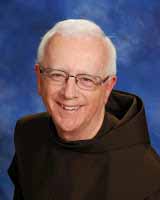
The pastor of historic St. Francis Seraph grew up in Batesville — and the ties between that small town and the Franciscan friars run deeper than most people know.
(Cincinnati) — One of Cincinnati’s oldest Catholic churches, St. Francis Seraph Church in the city’s Over-the-Rhine neighborhood, will close this summer after more than 160 years of worship and service. For most people, the story ends there — a beloved urban parish, another casualty of shifting demographics and aging religious orders.
But 46 miles away in Batesville, Indiana, the news carries a particular sting.
The man who broke the news to parishioners on a Sunday morning in January — announcing the closure during Mass to audible reactions from the congregation — is Father Alan Hirt, OFM. And Father Al, as he’s known, is a Batesville boy.
“Obviously born in Batesville,” Hirt said in a recent interview with WRBI. “My mother and dad were Helen and Charlie Hirt. One brother, Dennis.”
His family name is woven into the commercial fabric of southeastern Indiana. His uncle Leo was one of the founders of Hirt-Lindemann, the appliance business that eventually became a heating-cooling-plumbing fixture in the region (Hirt & Ellco). Hirt attended St. Louis grade school in Batesville before heading off to St. Francis Seminary in Cincinnati for high school, then a Franciscan college in Detroit, and finally theology school in Centerville, Ohio. He was ordained in 1977.
He is, he notes with a mixture of pride and melancholy, the last name on a plaque outside St. Louis Church in Batesville — a large marker listing every Franciscan sister and friar who came from that parish over the generations.
“It’s been a long time since another Batesville boy became a Franciscan,” he said. “Sadly.”
A 167-Year History Comes to an End
St. Francis Seraph has been serving the community of Over-the-Rhine since 1859. The church has operated for over 167 years and is connected to St. Francis Seraph School and a social ministries program.
Construction of the church began in 1858, built to serve the large wave of German Catholic immigrants who had flooded into the Cincinnati neighborhood then known as the Northern Liberties. Archbishop John Baptist Purcell invited Franciscan friars from Austria to provide pastoral care, and a permanent foundation was established.
The last Mass at the church is set for June 28, 2026. The two friars who staff the church will be reassigned to St. Clement Church in St. Bernard. That’s Father Hirt and Brother Timothy Sucher — just two men, in a building that once bustled with dozens.
The reasons for the closure are both financial and structural. The St. Francis Seraph Friary, which shares a building with the church, has, with the exception of the parish office, remained vacant for the past two years. The province that oversees the church, the Franciscan Friars of the Province of Our Lady of Guadalupe, has been working to sell the friary — but the buildings are literally connected, sharing utilities and walls, making a piecemeal sale a “real estate nightmare,” Hirt said.
But the deeper issue is one playing out in Catholic parishes across America.
“We are running out of a number of friars we would need to maintain all the ministries across the country that we now have,” Hirt explained. The move is part of a nationwide reorganization of Franciscan churches that leaders say will best serve parishioners by marshaling resources and putting their roughly 700 friars where they are needed most.
The finances of an aging religious order compound the problem. The province needs to fund nursing care and end-of-life services for a growing population of elderly friars — and Hirt says a portfolio of largely empty buildings drains resources every month, with utilities and minimal maintenance costs adding up even when no one is inside.
“When We Withdraw, the Parish Is Gone”
What makes the St. Francis Seraph closure especially painful — and different from other Franciscan withdrawals — is ownership. The friars don’t just staff the church. They own it.
When the Franciscans pull out of parishes in Indianapolis or Gary, Indiana, the parishes survive, handed off to diocesan priests. St. Francis Seraph has no such safety net.
“When we withdraw from St. Francis Seraph, we’re gone, the parish is gone,” Hirt said plainly. “That’s what’s really hard.”
It’s a story of decline that has played out for more than a half century in urban neighborhoods in Cincinnati and other Midwestern cities, as the number of priests declined and Catholics moved from city centers to the suburbs. Georgetown University researcher Rev. Thomas Gaunt, who studies Catholic demographics, noted that the neighborhoods have all changed, and what had once been a very Catholic neighborhood now has a small number of Catholic families.
The Franciscan friars have reaffirmed their commitment to serving Cincinnati even after the closure. St. Francis Seraph Ministries, which operates the Saint Anthony Center and provides food, shelter and other services to those in need in Over-the-Rhine, will continue its work even after the church closes.
The Batesville Thread
For WRBI listeners, the Franciscan connection to southeastern Indiana goes well beyond Father Hirt’s birth certificate.
The friars staffed St. Louis Church in Batesville from the parish’s founding in the 1860s until 2002 — nearly a century and a half of Franciscan presence in that community. The Franciscan Sisters of Oldenburg remain a living, active presence, as do the Franciscan friars, who continue to staff Holy Family Church in Oldenburg to this day. Their ongoing work — including outspoken advocacy on immigration and social justice issues — reflects the same tradition of engagement that defined St. Francis Seraph’s ministry to Cincinnati’s poor and homeless.
For Hirt, the closure is personal in ways that go beyond biography. He has watched the videos of his own homilies at St. Francis Seraph reach far away viewers — people who never set foot in Over-the-Rhine but found something in the Franciscan way of preaching that resonated.
“I’m almost a little surprised that this is even a story in Batesville,” he admitted, “but, you know, that’s great.”
What Comes Next
Father Hirt will continue as pastor at St. Clement Catholic Church in St. Bernard, right next to Roger Bacon High School, where the Franciscans will focus their Cincinnati presence going forward. Parishioners of St. Francis Seraph are encouraged to make the transition with him.
“I think that’s going to make the transition for a lot of people here at St. Francis, to align themselves with St. Clement,” Hirt said, “because people just really love the Franciscan way.”
At 75, Fr. Al isn’t planning to retire anytime soon. He says he wants to see the new community at St. Clement find solid footing before he steps back.
And in Batesville, his name remains the last one on that plaque outside St. Louis Church — a quiet monument to a tradition of young men from a small Indiana town who heard a calling, and gave their lives to it.
Father Al Hirt’s homilies from St. Francis Seraph Church are available on the parish’s YouTube page. The final Mass at St. Francis Seraph will be celebrated Sunday, June 28, 2026. St. Clement Catholic Church is located in St. Bernard, Ohio, adjacent to Roger Bacon High School.