

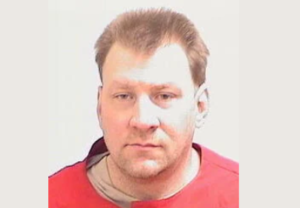
(Michigan City, IN) – Jeffrey Weisheit was executed by lethal injection Thursday morning just after midnight in Michigan City after spending 13 years on death row condemned as a child killer.
The Indiana Supreme Court ordered the execution of the 50-year-old Weisheit for the April 2010 murders of 8-year-old Alyssa and 5-year-old Caleb Lynch.
Weisheit was dating their mother when he set their Evansville house on fire with the children inside.
But, his attorneys argue that the State of Indiana should not have proceeded with the execution after buying the drugs from a pharmacy that they believe would have been shut down were it not the only place to procure the execution drugs.
A statement from Weisheit’s legal team following the execution outlined their doubts about the drugs and the protocols and procedures.
“The governor, the attorney general, and the corrections department—chose in unison to debase themselves to carry out his execution in the face of facts—not allegations, but incontrovertible facts—from records the Department of Correction produced and administrative proceedings of the Indiana Board of Pharmacy showing that on September 25,2026, the day after the pharmacy board ordered Pharmaneek, Inc. to show why it should not be immediately shut down, the Department of Correction paid Pharmaneek $275,000 to supply it execution drugs that, when sold as medicine to a hospital, cost $9,000,” read the statement.
Weisheiut’s team argues that the company was considered suspect until it became clear they would be needed to supply the lethal drugs, but got a pass until the execution was done.
“Instead of being shut down on October 5, as the pharmacy board originally envisioned, Pharmaneek preserved that sale of illicitly procured medicine off the gray market and outside legal channels and succeeded first in postponing its hearing to November 9, 2026—four days after the execution date for which it had just sold the execution drugs—and yet again pushed it off to December 14, 2026. Pharmaneek thus will continue its operations for at least another 10 weeks from the date that the Board of Pharmacy had originally set its hearing to suspend its license unless it showed why it should escape that fate after violating the terms of its probation.”
Statements from Gov. Mike Braun and Attorney General Todd Rokita did not controvert the accusations by the legal team, but rather addressed the facts head on, that the execution was ordered and was carried out.
“Jeffrey Weisheit’s case has been heard and reviewed numerous times by both state and federal courts, including the Indiana Supreme Court, since his conviction in 2013. These reviews have never resulted in an overturned sentence,” said Gov. Braun. “The State Parole Board issued a unanimous recommendation to deny Weisheit’s final appeal for clemency and that his execution proceed as scheduled. Today, Weisheit’s sentence has been carried out as ordered by the court.”
“Early this morning, the State of Indiana carried out the lawful sentence of Jeffrey Weisheit, delivering long-awaited justice for Alyssa Lynch and her brother Caleb, two innocent children whose lives were stolen in an act of unspeakable cruelty,’ said Rokita. “In April 2010, Weisheit bound young Caleb and deliberately set fire to the family’s Evansville home with both children trapped inside. He then fled to Kentucky, where he was arrested. A jury convicted him in 2013 of two counts of murder and arson and imposed the death penalty. That verdict and sentence withstood exhaustive review at every level of the state and federal courts, including the United States Supreme Court.
“This case stands as a clear affirmation that those who commit the most heinous crimes against the most vulnerable will be held fully accountable under Indiana law,” Rokita added. “My thoughts and prayers remain with the families of Alyssa and Caleb. Nothing can ever bring their children back, and the pain of this loss will never fully leave them. Yet, hopefully, with this justice being done, they may find some measure of peace.”
Weisheit’s team argues that the morality of the means of it being carried out is in question because the state, to preserve a way to put Weisheit to death, ignored the practices of a company they considered questionable until it was needed.
(Network Indiana contributed to this story)