

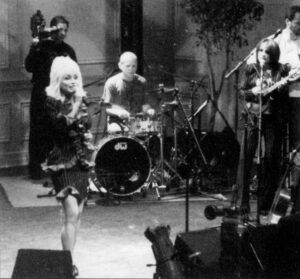
There are some people you know are going to die someday, but you don’t really believe it.
Dolly Parton was one of those people.
Maybe it’s because she had already been famous for longer than a lot of us have been alive. Maybe it’s because she seemed almost indestructible — this tiny woman with the enormous hair, the rhinestones, the laugh and a personality big enough to fill whatever room she walked into.
Or maybe we just didn’t want to imagine a world without her in it.
Dolly Parton died Tuesday at 80, following what her representatives described as a brief battle with cancer.
I’ve spent a good portion of my life playing Dolly Parton records.
That’s one of the strange things about working in radio for a long time. The people coming out of the speakers become mile markers in your own life.
You remember when a song was new. You remember what station you were working at when you played it. You remember which ones listeners requested over and over. And then, if you’re lucky enough to stick around long enough, you get to watch those same songs become classics.
Dolly had a bunch of those.
“Jolene.”
“Coat of Many Colors.”
“Here You Come Again.”
“9 to 5.”
“Islands in the Stream.”
And, of course, “I Will Always Love You.”
That last one pretty well sums up what happened this week.
The world loved Dolly.
And here’s the thing: practically everybody did.
Think about how rare that is anymore.
We live in an age when we can argue about absolutely anything. Give us five minutes and we’ll turn a hamburger, a football game or the weather forecast into a cultural grievance.
Somehow Dolly Parton largely escaped that.
Country fans loved her. Pop fans loved her. Rock stars loved her. Grandmas loved her. Kids knew her. People who wouldn’t know Porter Wagoner from a station wagon knew Dolly Parton.
And she managed to pull that off without ever seeming like she was trying terribly hard to make anybody like her.
She was just Dolly.
She could make fun of the hair before you did.
She could make fun of the clothes before you did.
She once said it took a lot of money to look that cheap, which may be one of the greatest examples of getting the joke before anybody else could tell it.
Underneath all of that, though, was an almost ridiculous amount of talent.
She reportedly wrote thousands of songs during her lifetime. She sold more than 100 million records. She built a business empire. She became a movie star. She helped turn Dollywood into an economic engine for the part of Tennessee where she grew up.
And then there was the Imagination Library.
That may wind up being as important a piece of the Dolly Parton story as any record she ever made.
The program she started to put books into the hands of little kids has distributed hundreds of millions of them around the world.
Think about that for a minute.
A little girl born in a one-room cabin in the mountains of East Tennessee grew up and eventually made sure hundreds of millions of books found their way into children’s homes.
That’s a pretty good life.
What always struck me about Dolly was that she never seemed embarrassed about where she came from.
She didn’t spend her career trying to outrun Appalachia.
She took it with her.
The poverty, the mountains, the family, the church, the homemade clothes — she turned all of it into songs. And in doing so, she reminded a lot of people from small towns and rural places that where you’re from doesn’t have to be something you apologize for.
That’s probably part of why she always felt familiar around here.
East Tennessee isn’t Southeastern Indiana, obviously, but the languages aren’t entirely different.
Family matters.
Home matters.
People remember where you came from.
And if somebody down the road needs help, somebody usually shows up.
Dolly understood that.
She also understood something about fame that a lot of famous people never seem to figure out: being important isn’t the same thing as acting important.
By every measurable standard, Dolly Parton was a huge star.
But somehow she remained approachable.
Maybe that was the greatest trick of all.
She looked larger than life while behaving like somebody you figured would probably sit down at your kitchen table and have a cup of coffee with you.
I’ve been thinking since the news broke about why her death seems to have hit people the way it has.
I don’t think it’s merely because we lost a great country singer.
We’ve lost those before.
I think Dolly represented something people are afraid we’re losing generally — the ability to be enormously successful without becoming cynical, angry or self-important.
She was ambitious without appearing ruthless.
Proud without seeming arrogant.
Funny without being cruel.
Generous without constantly reminding everybody she was generous.
That’s an awfully good combination.
And maybe that’s why, despite all evidence to the contrary, part of us figured Dolly would just keep going.
She’d keep making records.
Keep popping up on television.
Keep telling jokes about herself.
Keep sending books to little kids.
Keep showing up every now and then to remind us that she was still Dolly.
But eventually even the people who seem permanent aren’t.
The records remain.
The movies remain.
Dollywood remains.
Those millions of books remain.
And somewhere tonight, somebody will hear “Coat of Many Colors” or “Jolene” or “I Will Always Love You” for the first time.
That’s not immortality.
But it’s about as close as any of us are going to get.
Rest well, Dolly.
You did good.